
Carriage Clocks
WINDING
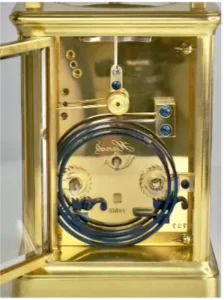
Winding the clock should only be done with the key provided with your clock or a good fitting replacement, gently place the end of the key against the square arbour and turn the key several turns until you feel a resistance. Nearly all carriage clocks that wind from the back wind anti clockwise, there are usually arrows on the movement around the arbours showing direction. After winding the clock, the clock mechanism should start to tick. However, sometimes the mechanism will require starting manually. Should this occur, lift the clock with the brass handle and gently turn the clock from left to right and it should start.
Setting Hands
To set the clock, most carriage clocks have a hand setting arbour located in the middle of the back plate. Place the rear end of the winding key over the arbour and move the hands gently round the clock to the correct time. If you have a striking carriage clock, make sure that when you turn the hands allow each hourly strike to finish its sequence to avoid the strike mechanism jamming. If the hands lock do not force them. Turn the hands back a minute or so only and allow the chime to finish and then gently move the hands on. Please remember that the hands should not be turned back more than 3 to 4 minutes as this will damage the levers that trigger the strike mechanism.
Regulation
Within a few days you should notice how well the clock is keeping time. If the clock is going too fast or too slow you can adjust the timekeeping by moving the regulator. This is usually a thin steel lever which is found at the top of the mechanism and normally extends to the rear of the clock. Either on the back plate of the clock or on the platform escapement you should see the letters F or S (this represents fast or slow). Should the clock gain time, move the steel lever to S (slow) or if it is slow turn it to F (fast). The adjustment of the regulator should be done in very small movements. For adjusting the clock by 1 minute a day move the regulator half a millimetre at a time. We would suggest that you make a small adjustment and then leave it for a day or two to see how much it has lost or gained before making another adjustment.
Maintenance
To maintain the clock you should have it checked and serviced every 4-5 years. Do not attempt to oil a clock yourself. This should be done by a qualified repairer. Over-oiling a clock can affect the running and condition of the clock.